


Shiqi Ren

M.S. Student in Aerospace Vehicle Design

I am a master’s student at the Innovation Academy for Microsatellites, Chinese Academy of Sciences, in Shanghai. My research focuses on spacecraft rendezvous and proximity operations—specifically relative pose estimation, maneuver triggering, and safety-guaranteed braking—as well as tendon-joint coupling in robotic manipulators.

Shiqi Ren

Education

  1. China University of Mining and Technology

    –

    Bachelor’s degree in Mechanical Engineering
    Focus on industrial robotics

  2. University of Science and Technology of China

    2024–2025

    Year 1 of the joint master’s program
    Graduate coursework in Aerospace Vehicle Design

  3. Chinese Academy of Sciences

    2025–present

    Years 2–3 of the joint program · Expected graduation in June 2027
    Research at the Innovation Academy for Microsatellites, Shanghai

Research

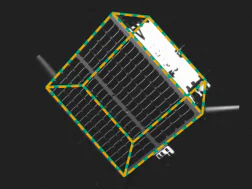
The predicted wireframe nearly overlaps the reference on the best-ranked Lightbox frame. The orientation error is 0.13 degrees and the position error is 0.33 cm.

Visual navigation

Single-image spacecraft pose estimation

How accurately can a compact vision model estimate a spacecraft’s relative position and orientation from one image?

Abstract for Single-image spacecraft pose estimation

The model detects image keypoints, then uses their known 3D positions to recover the target’s six-degree-of-freedom pose. The backbone study compares visual models under the same geometric solver. A follow-up tests four-rotation refinement on held-out SPEED+ Lightbox and Sunlamp images after supervised adaptation.

MambaPose: A Parameter-Efficient Selective State-Space Backbone for Keypoint-Based Monocular Spacecraft Pose Estimation
Shiqi Ren and Pengcheng Wang · Manuscript, 2026
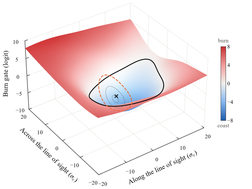
Surface showing burn and coast decisions as the estimated relative velocity changes.

Orbital guidance

Burn timing for far-range rendezvous

With noisy navigation, when should a spacecraft fire its thrusters, and when should it coast?

Paper
Abstract for Burn timing for far-range rendezvous

A recurrent policy uses navigation estimates, their uncertainty and past maneuvers on an approach from 10 km to a 100 m handover. Each proposed command is checked against a braking maneuver. In matched nominal and combined-fault simulations with 0.5–5% navigation error, mean fuel–time cost was 4–26% lower than for the adaptive planner on missions both methods completed.

Recoverability-shielded reinforcement learning for far-range spacecraft rendezvous
Manuscript, 2026

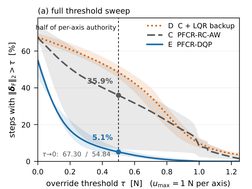
Exceedance curves for the magnitude of docking thrust corrections at different thresholds.

Learning-based control

Learning from thrust corrections during docking

How can a docking policy learn from the changes a safety filter makes to its commands?

Paper
Abstract for Learning from thrust corrections during docking

We use the local geometry of a control-barrier-function quadratic program to identify the thrust directions that conflict with active constraints. In a five-seed simulation comparison, mean total impulse was 77.2 N·s for the selected policies and 205.9 N·s for the barrier-aligned baseline. The paired interval for the docking-success difference included zero.

Local CBF-QP Projection Credit Assignment for Reinforcement Learning in Terminal-Phase Spacecraft Rendezvous and Docking
Shiqi Ren and Pengcheng Wang · Author preprint, 2026

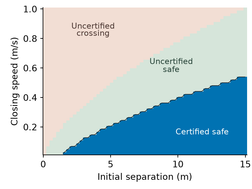
State map of initial separation and closing speed. A black curve bounds the certified braking region.

Spacecraft dynamics

Braking with delayed thrust

Which commands leave enough room to stop when a thruster takes time to build force?

Abstract for Braking with delayed thrust

We work backward from the force needed during a braking maneuver to obtain a constraint on the command sent now. The sampled actuator model includes lag, uncertain thrust effectiveness, dead zones and saturation.

Actuator-Preimage Braking Certificates for Terminal Spacecraft Approach
Shiqi Ren and Pengcheng Wang · Manuscript, 2026
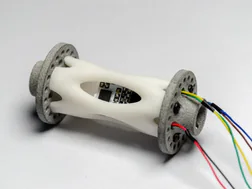
An assembled tendon-driven arm segment with guide disks, onboard electronics and wiring.

Robotics

Coordinated motion in tendon-driven arms

How can one arm section move while its neighbors stay still when a tendon spans several joints?

Abstract for Coordinated motion in tendon-driven arms

I model how tendon lengths and tensions relate to joint motion in a six-section arm with twelve degrees of freedom. I am studying how routing geometry could guide motion of one section while limiting motion in adjacent sections. A separate simulation study considers recovery when one tendon loses effectiveness.

Ongoing research

Open Source