Selected researchRobotics
Coordinated motion in tendon-driven arms
Tendon-driven robotics · Ongoing research
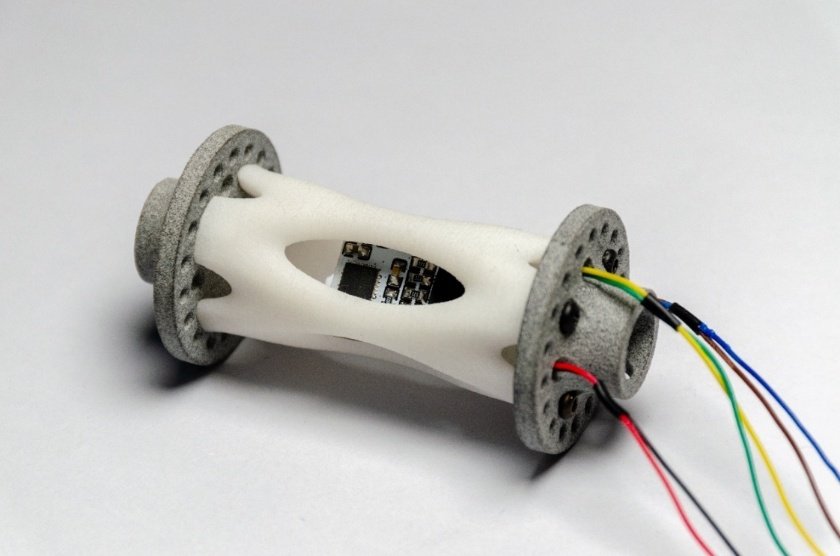
How can one section move on its own?
The arm has six sections connected by universal joints. Each joint can pitch and yaw, giving the arm twelve rotational degrees of freedom. Eighteen tendons run from the drive box, with three terminating at each section.

Bending an upstream joint changes the length of the route to a downstream section. That coupling gives us a concrete control problem. Can we choose a set of tendon length or tension changes that bends one section while limiting motion in its neighbors? I am studying how the routing geometry constrains those choices.
When one tendon loses effectiveness
In a separate single-section simulation, one tendon suddenly transmits only part of the force requested by the controller. The controller observes the motion but does not know which tendon weakened. One strategy uses the mismatch between predicted and observed motion to identify the affected tendon and reassign tension.
| Controller | Local model | Nonlinear model |
|---|---|---|
| Nominal tension allocation | 4 / 24 | 1 / 4 |
| Identify and reassign tension | 24 / 24 | 4 / 4 |
| Learned residual, one observation | 0 / 24 | 0 / 4 |
| Learned residual, eight observations | 0 / 24 | 0 / 4 |
The local-model set included 4 healthy and 20 fault episodes. The nonlinear check used 1 healthy and 3 fault episodes. Both used noiseless simulated observations. The two learned policies each trained for 50,000 steps with one seed and had a narrower tension adjustment range than the allocator. The next comparison will give the controllers the same range.