Acta Astronautica manuscript · Revised 22 October 2026
Recurrent impulsive guidance and its recoverability shield for a geostationary approach from 10 km to a 100 m handover.
Motivation
Far from a target spacecraft, an apparent change in relative position or velocity may come from navigation error. Replanning after every change can spend propellant on unnecessary corrections. Waiting too long can leave too little room to enter the approach corridor or brake before handover.
We study when to burn, when to coast and how much velocity to change during a geostationary rendezvous. The chaser receives an uncertain navigation estimate and may encounter thruster efficiency loss, misalignment or bias during the approach.
Guidance framework
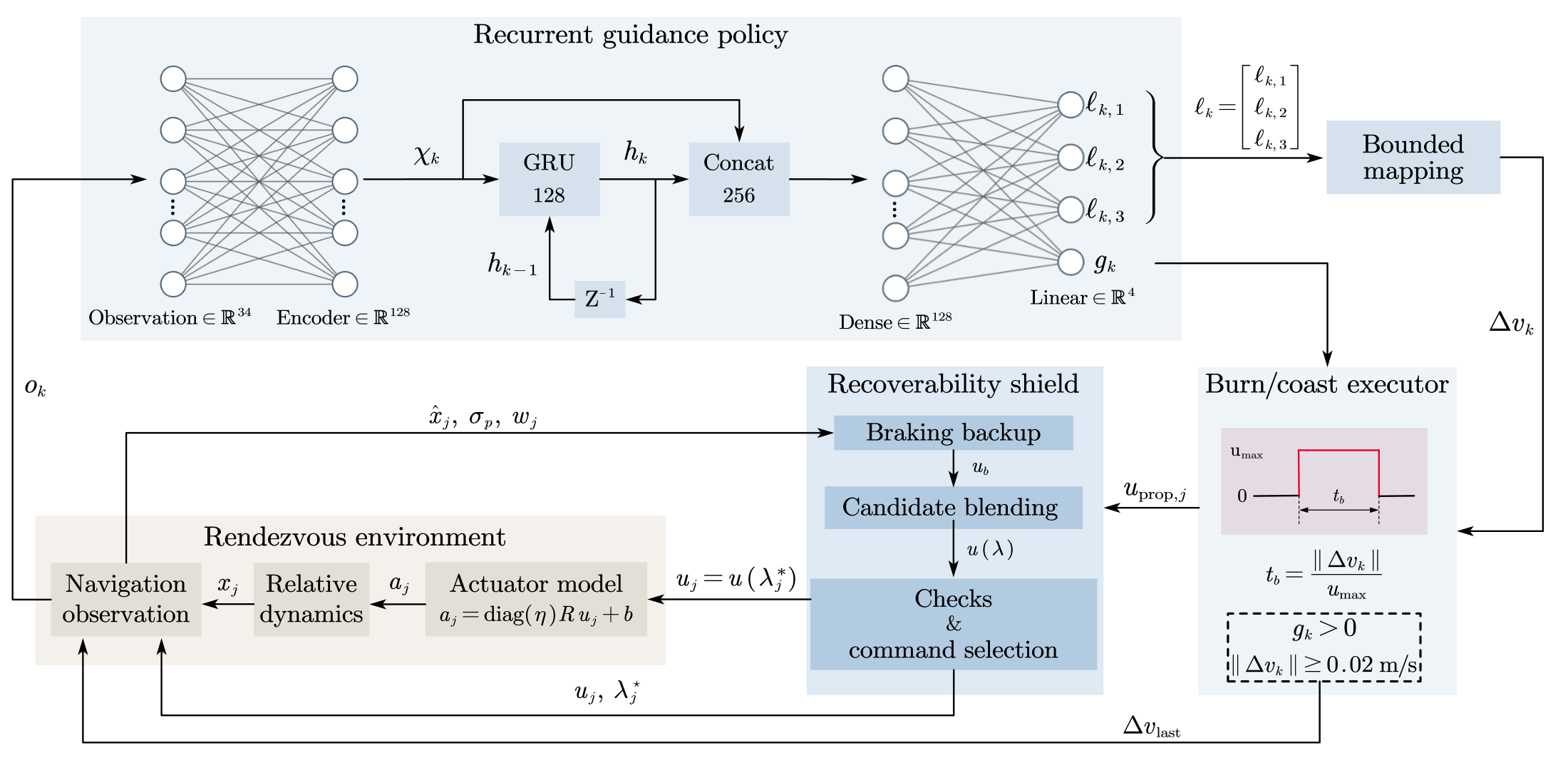
The recurrent policy and the shield operate at different rates. Figure 1 above follows a decision from the navigation estimate through the burn executor and back to the next observation.
Learn from an adaptive planner. Dataset aggregation trains the policy on states visited by the student. Imitation-regularized proximal policy optimization then refines burn timing and magnitude against the mission’s fuel–time objective.
Choose a burn or coast every five minutes. A gated recurrent unit combines the estimated relative state, reported navigation uncertainty and manoeuvre history. Its outputs are a burn gate and a three-axis velocity increment.
Check the thrust command every second. The shield predicts the next hold interval and a braking continuation. It tests the proposed command and blends with a braking backup, using a four-standard-deviation position margin around the geometric constraints.
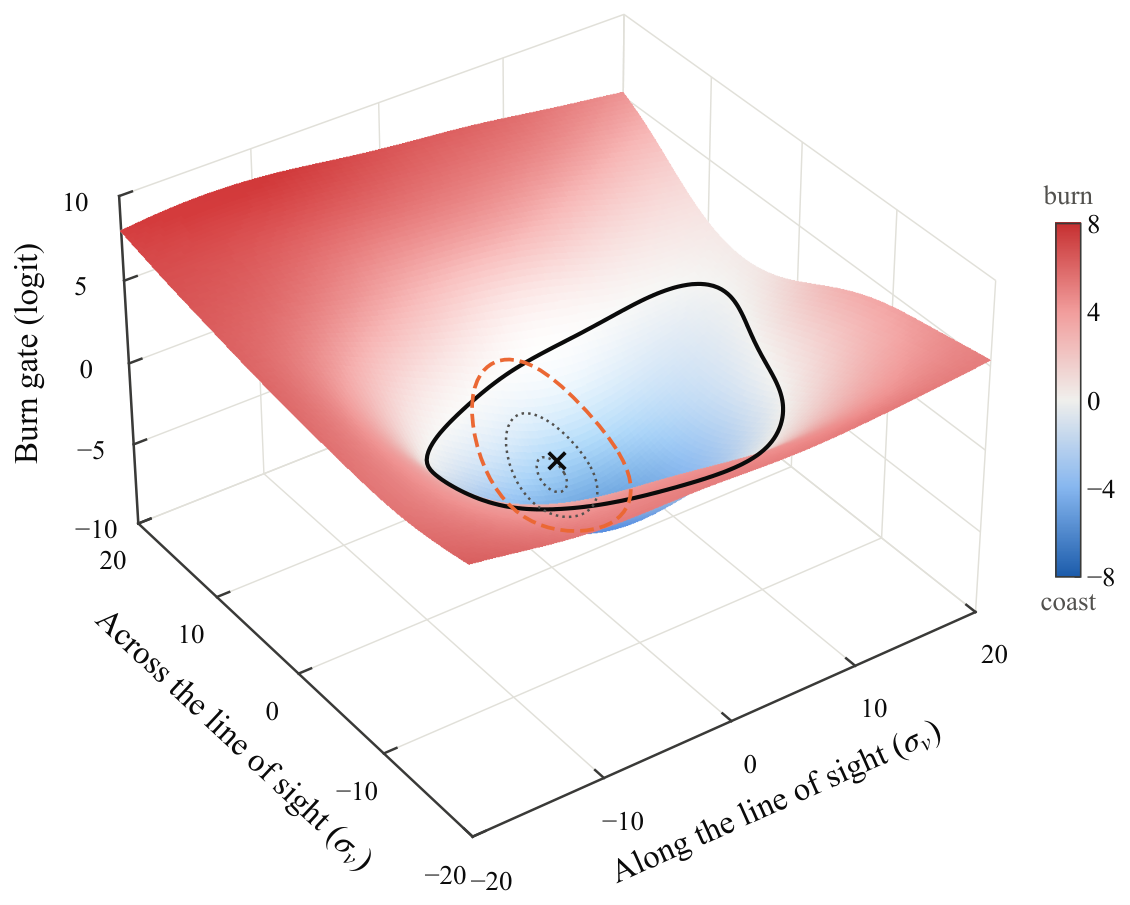
At 4.4 km from the target, the policy tolerates a larger velocity-estimate change along the line of sight than across it before requesting a burn. Figure 7
Spacecraft rendezvous
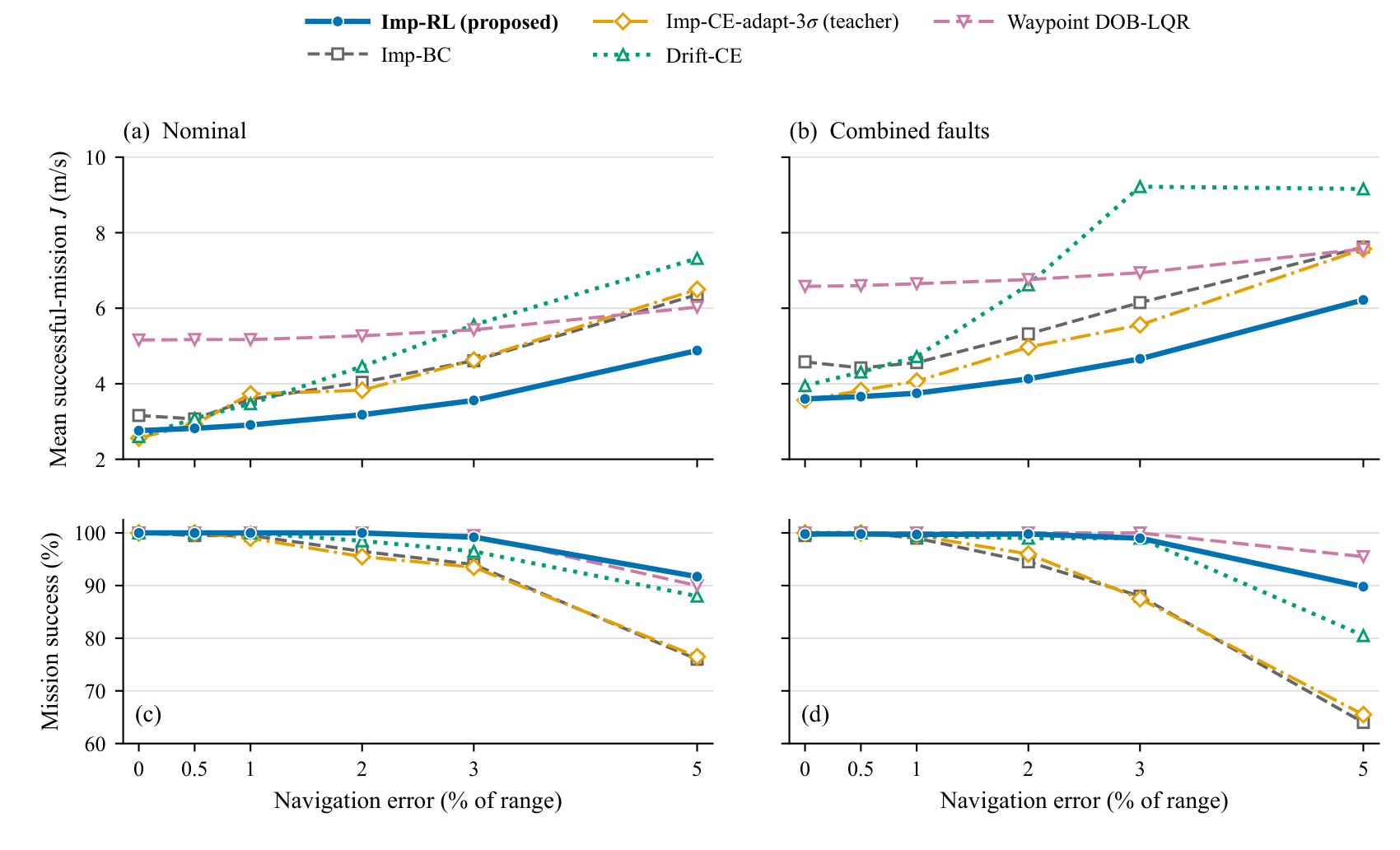
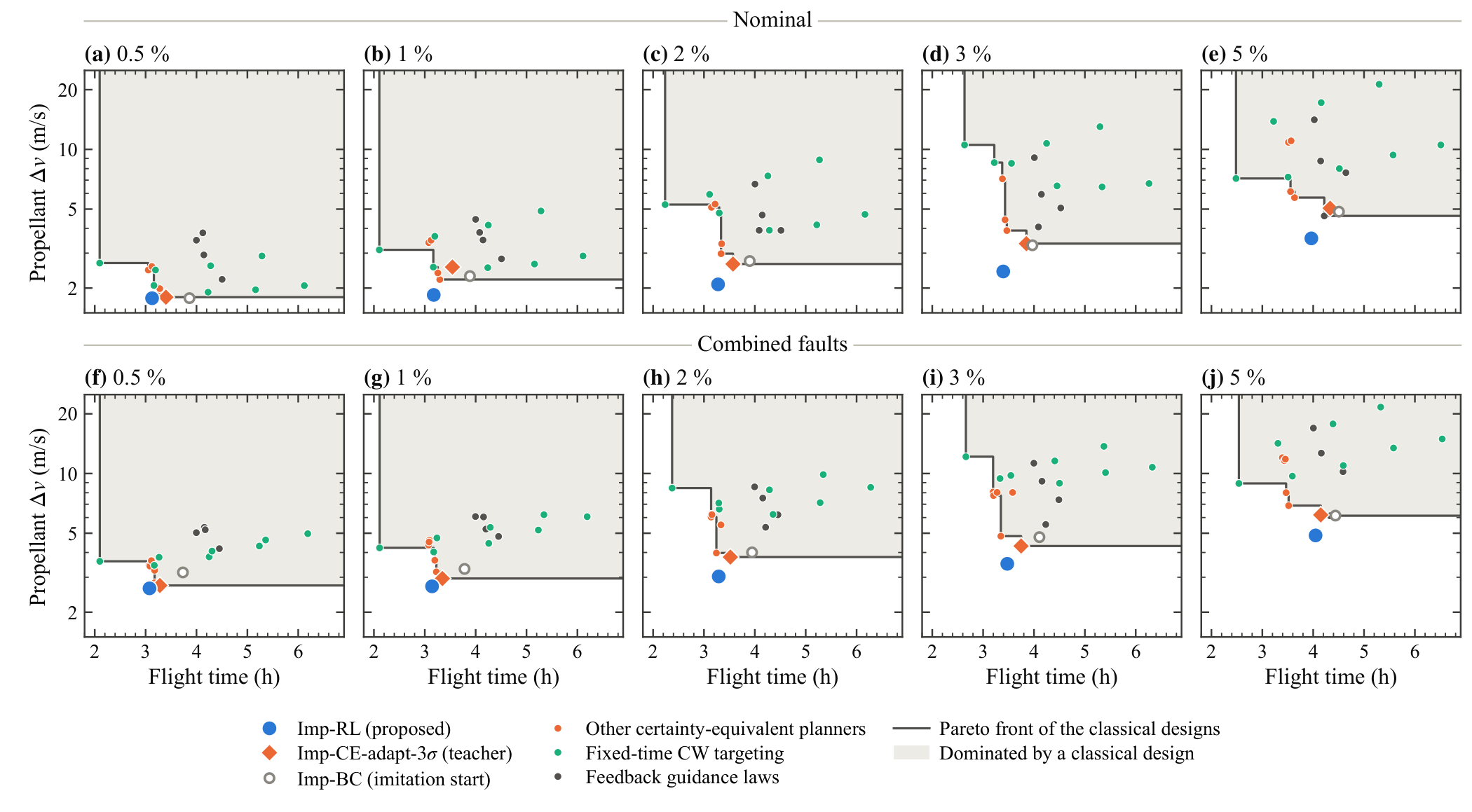
The evaluation compares the learned policy, Imp-RL, with 18 classical guidance designs on matched missions. Native Tudat simulations include Earth’s oblateness, lunar and solar gravity, and solar radiation pressure. At navigation errors of 0.5–5% of range, Imp-RL has the lowest mean fuel–time cost on successful missions in both nominal and combined-fault conditions.
A representative approach
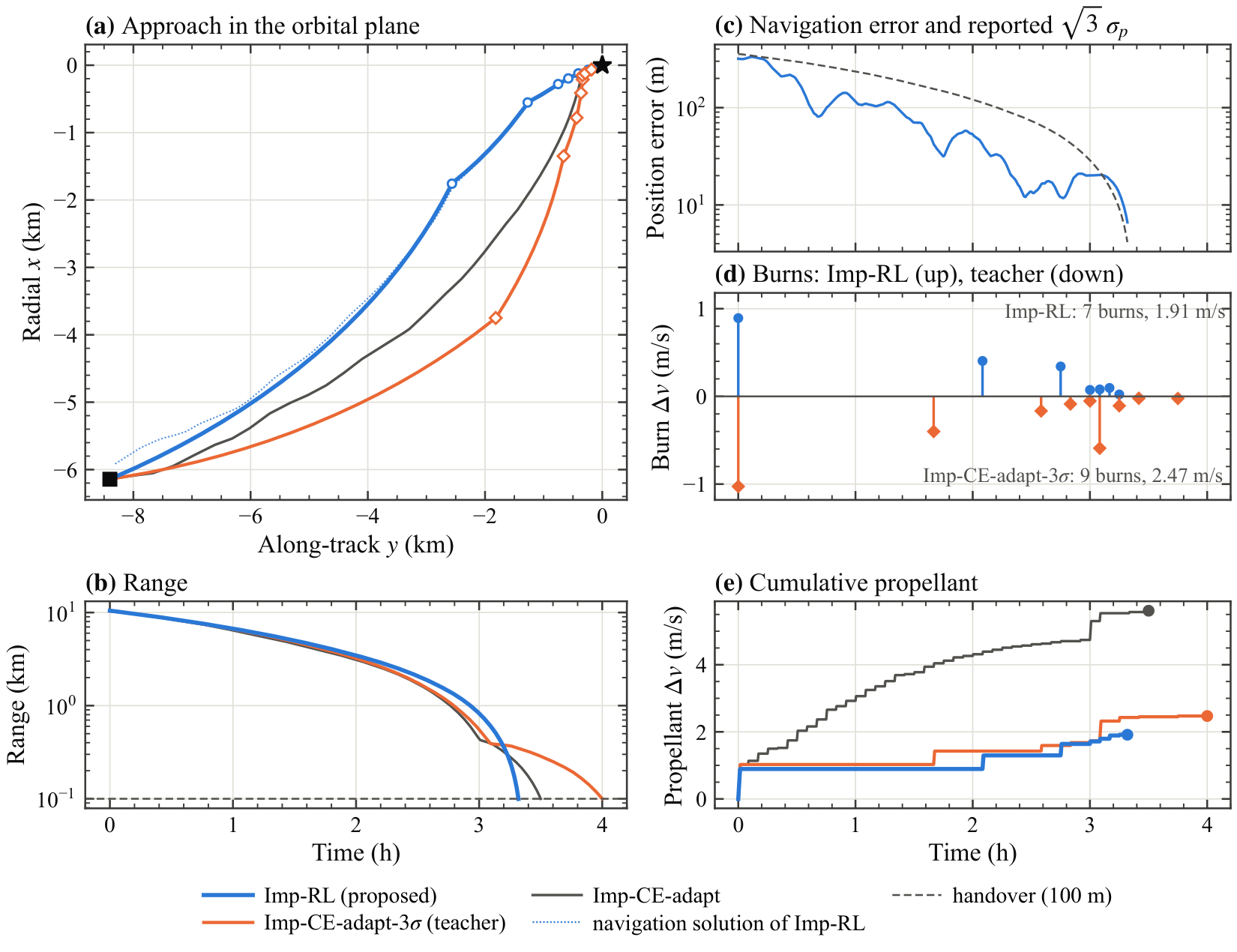
In this nominal mission at 2% navigation error, the learned policy uses 7 burns and 1.91 m/s to reach handover in 3.32 h. Its adaptive teacher uses 9 burns and 2.47 m/s over 4.00 h. The first correction after the policy’s initial burn comes more than two hours into the flight.
Mission 186, Clohessy–Wiltshire replay. The blue and orange markers in panel (a) follow the policy and its teacher as mission time advances. Figure 6
Navigation errors and mission completion
At 5% navigation error, Imp-RL completes 91.7% of nominal missions, compared with 76.5% for its teacher. Under combined faults, the figures are 89.8% and 65.5%. The artificial potential field controller completes all missions at this error level, at a higher fuel–time cost.
Successful-mission mean cost and completion rate as the navigation error increases. Figure 2 · Tables A.2–A.3
Fuel and flight time
Across 0.5–5% navigation error, the policy’s fuel–time cost is 4–26% lower than the teacher’s on missions both complete. One hour of flight is weighted as one third of a metre per second of Δv. With exact navigation, the teacher has the lower nominal cost. Imp-RL arrives 0.49 h earlier but expends 26% more propellant.
Each point gives mean propellant expenditure and flight time over a method’s successful missions. Grey steps trace the classical Pareto front. Figure 3
Constraint audit
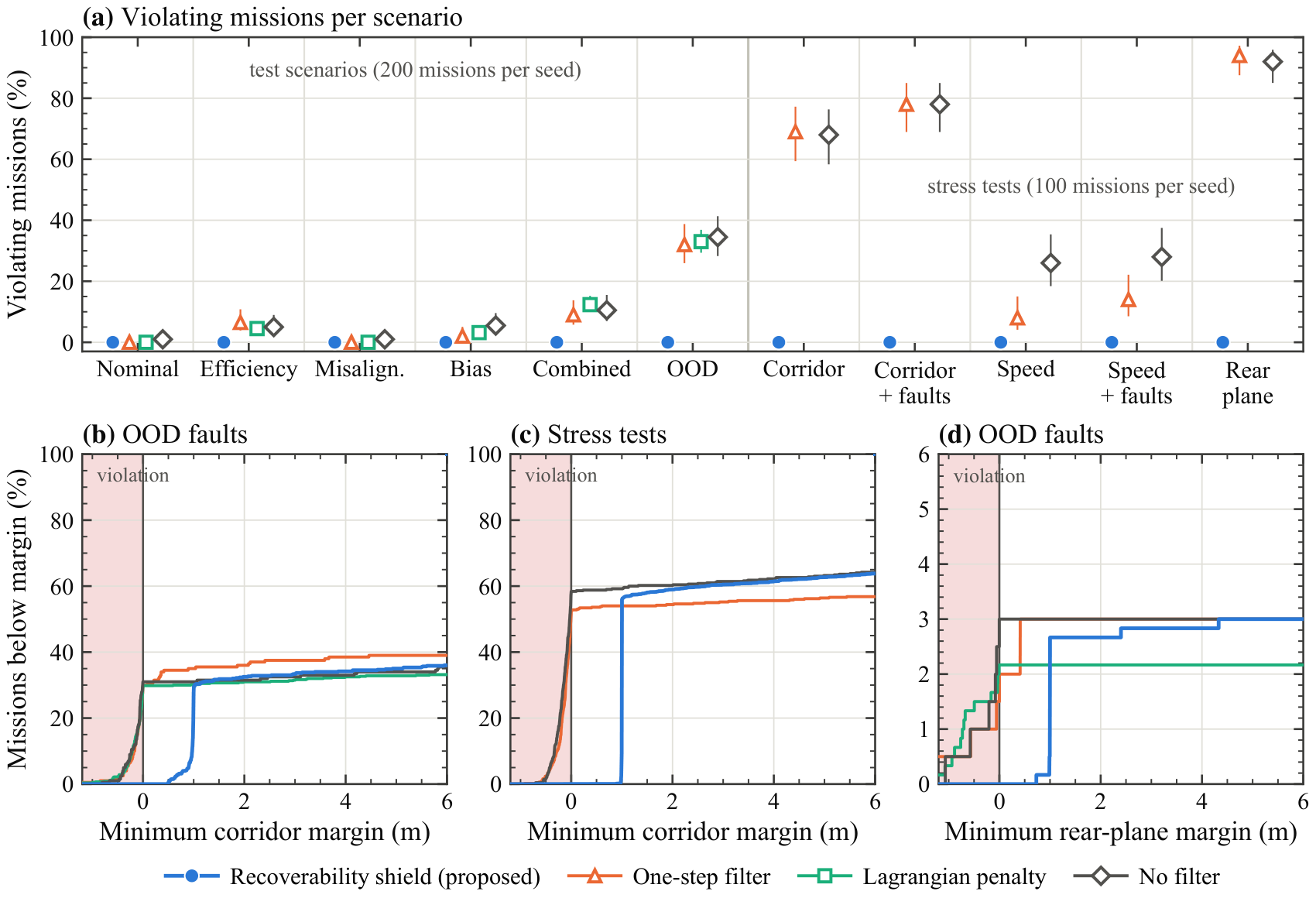
The true-trajectory audit records zero violations through termination in 22,800 test missions for Imp-RL. Five violations occurred in 582,010 training episodes. If no candidate thrust command passes the shield, the spacecraft applies the backup for one second. The audit includes that interval and the mission ends as a failure.
Exact-navigation ablations compare the recoverability shield, a one-step filter, a penalty and unfiltered guidance. Figure 8